Why Are Patterns Important?
In mosque carpets, patterns are related not only to visual harmony but also to the order of worship.
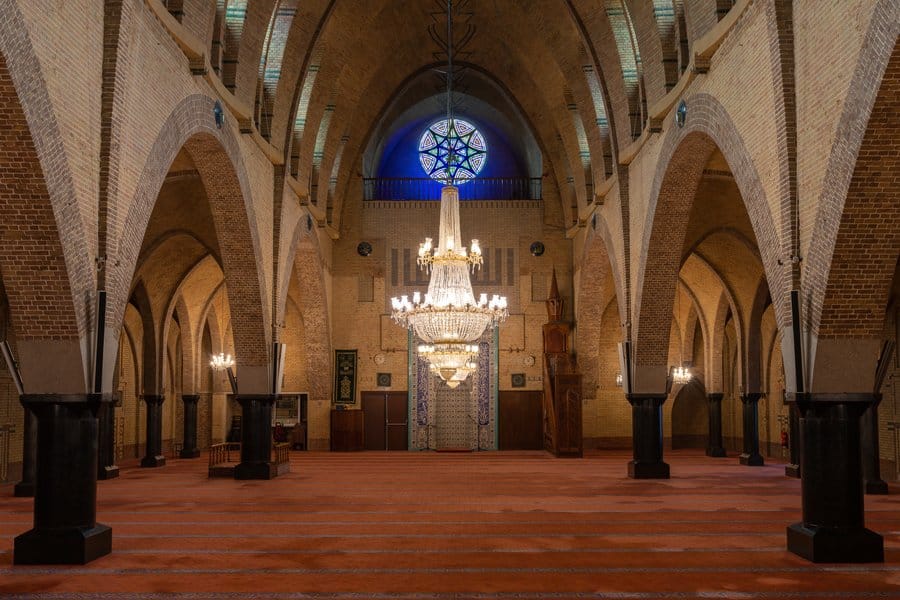
Symmetrical compositions and repeating motifs create a sense of “order” within the space, helping to reinforce the alignment of prayer rows.
Choosing the right pattern enhances harmony with architectural details and can make the space feel more spacious or more balanced than it actually is.
- Geometric Motifs
- Arabesque Forms
- Prayer Row Alignment
- Spatial Harmony
Repeating patterns across large surfaces create a uniform and harmonious rhythm.
The mihrab form is a classical composition that strengthens the sense of direction and focal point.
Geometric Motifs
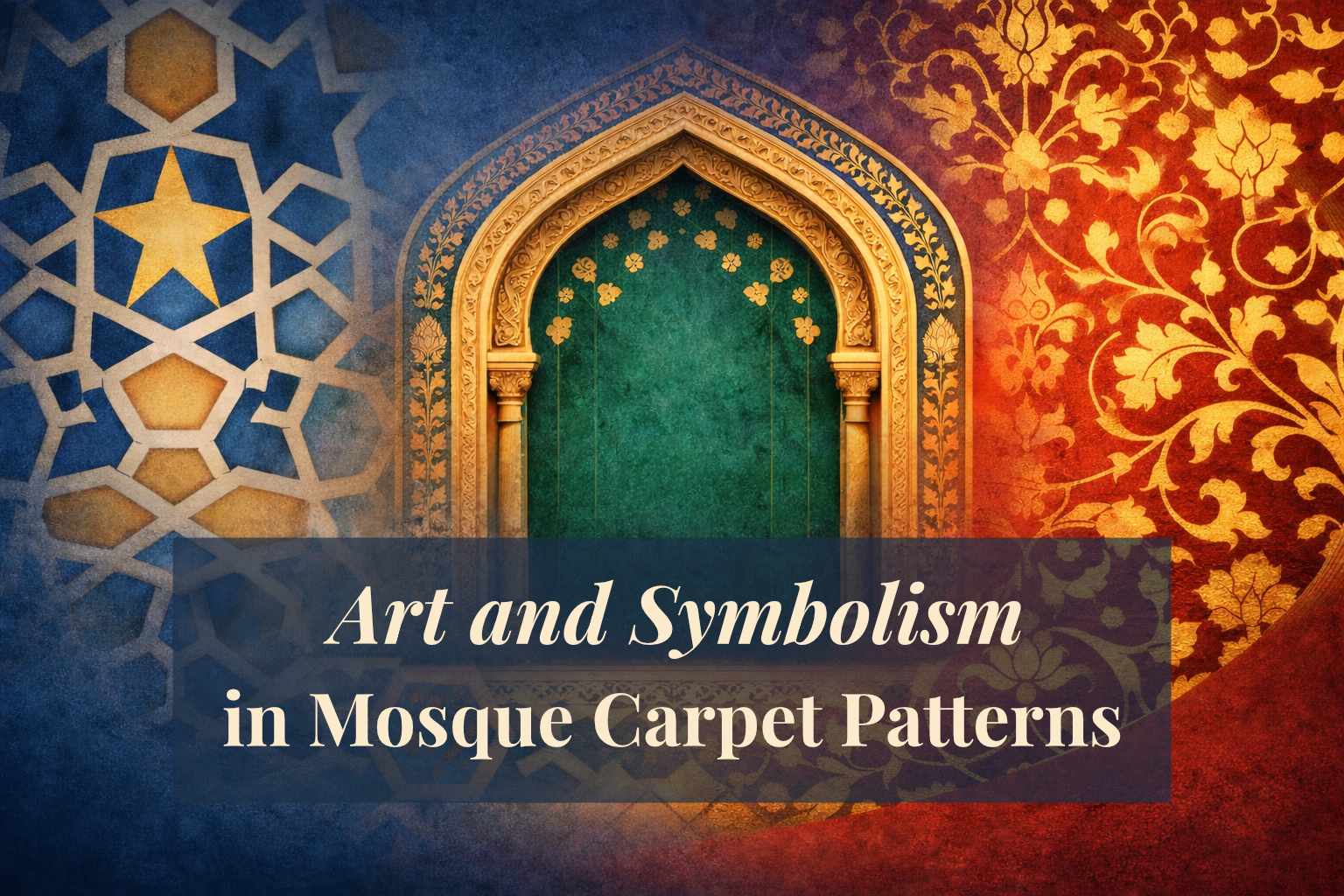
Geometric motifs form a visual language of “order,” composed of polygons, stars, and interlacing lines.
This language balances spatial perception through repetition (rhythm) and symmetry.
Symmetry: Creates a calm composition that does not tire the eye.
Rhythm: Helps the eye move smoothly throughout large spaces.
Scale: As the scale of the pattern increases, the space feels more “full”; as it decreases, the space is perceived as more “serene.”
Arabesque and Floral Forms
Arabesque forms, with their flowing vegetal motifs and compositions of leaves and branches, give the space a soft and graceful character. When used in tones that harmonize with classical mosque architecture, they create a warm and inviting atmosphere within the interior.
Balance
Floral motifs can soften rigid geometric lines.
Harmony
They work well alongside classical columns, domes, and calligraphic ornamentation.
Simplicity
Instead of dense motifs, a “simple border with a calm base” can create a sense of spaciousness.
Mihrab / Prayer Row Layout and Spatial Impact
| Criterion | What Does It Provide? | Tip |
|---|---|---|
| Prayer Row Lines | Orderly alignment | If the lines are too dominant, they may make the space feel narrower; choose proportions carefully. |
| Border | Framing effect | Thick borders create a “classical” feel, while thin borders convey a more “spacious” impression. |
| Ground Pattern | Rhythm and continuity | Denser ground patterns can better camouflage dirt in areas with heavy congregation use. |
Quick Note
When choosing patterns, “architecture + lighting + space size” should be evaluated together. The same pattern can appear very different in a small prayer room compared to a large mosque.
Practical Tips for Choosing Patterns
1) Space Size
In large spaces, smaller repetitions create a calmer feel, while medium to large repetitions provide a more “classical” appearance.
2) Light and Color
If natural daylight is limited, very dark ground colors may make the space feel oppressive; mid-tones are a safer choice.
3) Border Balance
Borders frame the architecture. Overly thick borders can become dominant in smaller spaces.
4) Usage Intensity
In high-traffic areas, pattern density and yarn quality should be considered together for ease of cleaning and durability.
Frequently Asked Questions
Does pattern selection affect the alignment of prayer rows?
Yes. The proportion of prayer row lines to borders and the scale of the pattern can either strengthen or weaken the perception of alignment.
Which pattern appears more spacious in large mosques?
Does the same pattern look the same in every mosque?
No. Lighting, ceiling height, wall color, and overall space size can significantly change how a pattern is perceived.